The Best Pillows for Stomach Sleepers

Stomach sleeping is the position a tall pillow punishes most. Your head is already turned to one side so you can breathe, and a thick pillow pushes it upward at the same time. The neck ends up holding a twist on two axes for seven or eight hours a night. Most people blame the mattress, buy a softer pillow, and change nothing that matters. The fix a lot of stomach sleepers never try is going much lower, down to 1.75" or 2.75", which is roughly half the height of a standard pillow off a store shelf. At that loft your head sits close to level with your spine. Here is how to find your number.

Where we stand. Bluewave makes thin pillows, so the picks below are ours. The height advice holds no matter whose pillow you buy, and there are 9,000+ Amazon reviews you can check our claims against.

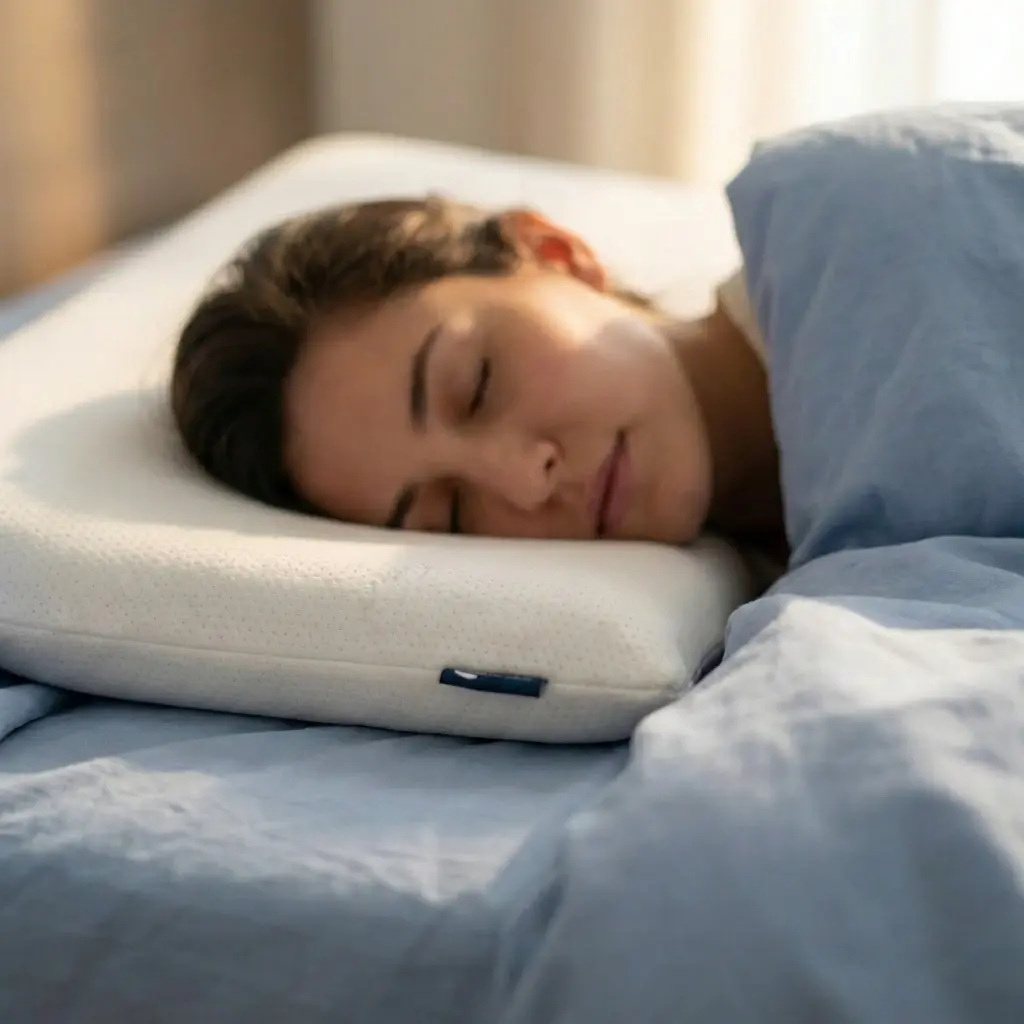
A woman asleep on her stomach with her head turned to one side, resting on a flat white memory foam pillow
Head turned to the side and still close to the mattress. That is the job a low profile pillow does for a stomach sleeper.

Why stomach sleepers need the thinnest pillow in the house

Face down, your head has to rotate close to 90 degrees so your nose is not buried in the mattress. That turn alone asks a lot of a neck over a full night. Put a pillow under it and you add a second angle on top: the head lifts while your chest and shoulders stay flat. Now the neck is twisted sideways and bent backward at once. That is the two axis problem, and it is why the same pillow that feels fine to a side sleeper can leave a stomach sleeper stiff by morning.

Most pillows in stores run 5 to 7 inches thick. That height exists for side sleepers, who have a real shoulder-sized gap to fill between ear and mattress. On a stomach sleeper the same pillow tips the head well above the line of the spine and parks it there until the alarm goes off.

Drop to 1.75" or 2.75" and the math changes. You still get something soft under your cheek, but your head stays near level with your spine. The sideways turn does not go away, since that part comes with the position. The upward push is the part you can take off the table, which is why the best pillow for stomach sleepers is usually the flattest one they can live with.

If you tuck an arm under the pillow

Plenty of stomach sleepers sleep with a forearm wedged under the pillow, or under the pillow and their head both. The pillow now has two jobs: support your head and cushion the arm, which adds a little height of its own. Go too thin and your knuckles press into your cheek all night. Most arm tuckers land at 2.25" to 2.75", enough foam to soften the arm without pushing the head up.

Which height for which stomach sleeper

How you sleep Height Why
Dedicated stomach sleeper, all night 1.75" to 2.75" Head close to flat, with bigger builds toward the top of the range
Mostly stomach, some back 2.25" to 2.75" Enough support for the nights you roll over, still low when you are face down
Arm tucked under the pillow 2.25" to 2.75" Thick enough to cushion the arm, which adds a little height of its own
Stomach sleeper who runs hot Same heights Add phase-change cooling on the same foam. See the Max Cool series

These are starting points, not rules. Nudge up or down for your build and how firm your mattress is, since a soft mattress lets your chest sink and adds height you did not ask for. Every low profile pillow we sell comes with 30-day returns through Amazon, so a first guess is never a permanent one.

Our stomach sleeper picks

Start with our best seller, then the premium adjustable, then the specialty heights for dedicated face-down sleepers. All made with CertiPUR-US® certified foam.

Bluewave Ultra Slim 2.75 inch gel memory foam pillow
Start here

Ultra Slim 2.75"

Our most popular height and our least returned, which is the honest reason it is here. This is the right one for stomach sleepers who roll onto their back some nights and want a single pillow that handles both. Medium firm gel memory foam, cut to an exact 2.75" that stays 2.75".

$44.99
Bluewave Versalayer adjustable height memory foam pillow
Premium adjustable

Versalayer 0.75" to 6"

Our premium pillow, and the one that suits every sleeper. Six layers adjust from 0.75" to 6" in 0.25" steps, so a stomach sleeper can build a 2" pillow tonight and change their mind next week. If you want certainty instead of a guess, this is it.

from $59.99
Bluewave Hyper Slim 2.25 inch gel memory foam pillow
The in-between

Hyper Slim 2.25"

This one splits the difference. It suits stomach sleepers who found 2.75" a touch tall, and it is the usual starting point for arm tuckers. Same single piece of gel memory foam as the rest of the Slim Series, just a quarter inch of breathing room either way.

$44.99
Bluewave Extra Slim 1.75 inch gel memory foam pillow
Flattest we make

Extra Slim 1.75"

At 1.75" this is the thinnest one we make. It is built for smaller-framed stomach sleepers who stay face down all night and want the head as close to flat as it gets. Your head sits nearly flat and the neck holds the smallest angle it can. Fair warning: it is too low for almost everyone else.

$44.99

One honest caveat

Sleep doctors generally consider stomach sleeping the hardest position on the neck and lower back. The neck holds a turn all night, and the middle of the body sinks, which arches the spine. If you can retrain yourself to sleep on your back or your side, that will likely help more than any pillow, ours included.

Many people try and never get there. If you have made a real effort and you still wake up face down every morning, work with the position instead of fighting it. The right height makes stomach sleeping far kinder on your neck than the tall pillow you are on now. That is the most common advice we give, and we are a family-owned shop in Indian Rocks Beach, Florida that has sold 350,000+ pillows.

Stomach sleeper questions, answered

Most stomach sleepers land between 1.75" and 2.75", with body size deciding where. Smaller builds do well at 1.75", where the head sits almost flat. Bigger builds usually want 2.25" or 2.75". If you roll onto your back for part of the night, 2.75" covers both positions without much compromise. Your mattress matters too. A soft mattress lets your chest sink, which adds height to whatever pillow you are on, so lean lower.

A low pillow is generally better than no pillow. Lying face down straight on the mattress lets your head drop below the plane your spine is resting on, so the neck bends the other way instead of staying level. A 1.75" pillow keeps things close to level without pushing your head up, and it gives your face something soft to turn against. If you have slept with no pillow for years and feel fine, there is no reason to change.

Aim for 2.25" to 2.75". The pillow is doing two jobs here: supporting your head and cushioning your forearm, and the arm adds a little height of its own. Go too thin and the arm ends up doing the pillow's work. Our Ultra Slim at 2.75", our best seller, is the usual pick, and the Hyper Slim at 2.25" suits arm tuckers with a smaller build. Both cushion the arm without pushing your head far off level.

Some do, and many find it helps. Lying face down lets the middle of the body sink into the mattress, which arches the lower back. A thin, flat pillow under the pelvis, not under the stomach, may lift the hips just enough to ease that arch. Keep it low, an inch or two at most, or you trade one problem for another. It is worth trying if you wake up sore in the lower back. If the soreness sticks around, talk to a doctor.

Usually the twist. Face down, your head has to turn roughly 90 degrees so you can breathe, and it holds that turn for hours. A tall pillow adds a second angle by pushing the head up while your chest stays flat, so the neck is turned and bent at the same time. Many sleepers find that a lower pillow eases the morning stiffness, because it takes the upward push out of the picture. If the pain is severe or does not go away, see a doctor.

Get your head level

Five exact heights from 1.75" to 4.0", free shipping, and 30-day returns through Amazon.

Shop the Slim Series